
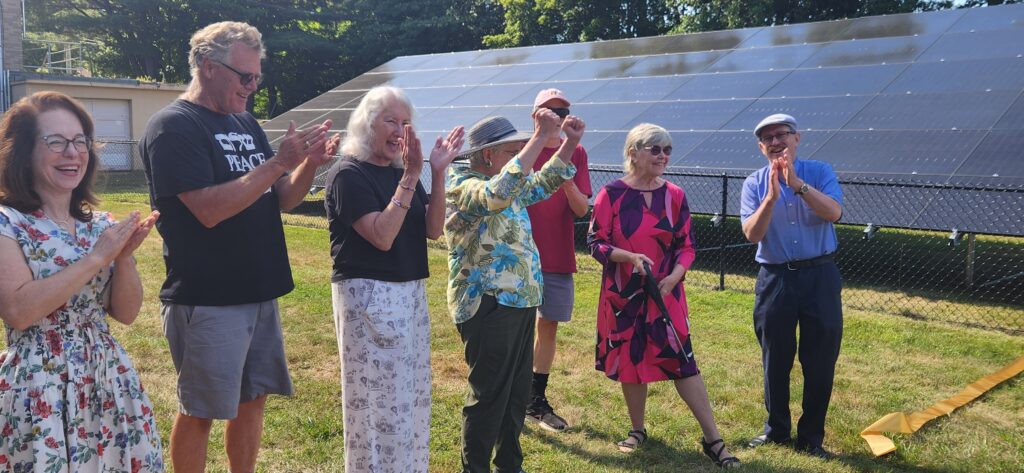
Temple Bnai Israel in Willimantic is a great inspiration of how far Houses of Worship (HOWs) can go to not only improve the energy efficiency of their buildings, but also increase resilience, reduce utility costs, and boost the overall sustainability of their operations. With a congregation of about 100 members, Temple Bnai Isreal is smaller in size but mighty in its enthusiasm and drive for a greener future.
In recent years, their beautiful, mid-century building needed major repairs. Built in the 1960’s, the building had many flaws ranging from poor thermal comfort to rising energy costs, which motivated the exploration of potential energy efficient solutions.
In 2024, Temple Bnai Israel completed an initial energy efficiency project through the Small Business Energy Advantage (SBEA) program available through the utilities, replacing lighting throughout the building. Significant rebates from Energize CT and an Energy Efficiency Small Grant from IREJN reduced the costs of the project and the synagogue was pleased with the reduction in their utility bills.
However, challenges still remained. The roof needed repair and the synagogue was paying thousands to keep their ailing natural gas system operating. The lack of air conditioning in the summers was also a problem, especially as climate change has increased the number of health-threatening heat waves. With strong support from the rabbi and the Tikkun Olam committee, the congregation developed a robust plan and put it into action. Together, they decided to replace the roof, replace the natural gas system with an electric heat pump system for heating and cooling, and install a large solar array to power it all.
Targeted outreach through brunches personally introduced members to the proposed initiatives and gave them the chance to ask questions, as well as to identify and meet with those who might be interested in supporting the efforts financially. After several years of planning and hard work, Temple Bnai Isreal now celebrates achieving net-zero!
IREJN had a chance to talk to Sheila Amdur and Doreen Simonsen about their journey to net zero.
What advice would you give to HOWs that are interested in starting similar projects?
- Get everyone excited – Although increased sustainability is always a main benefit of making energy efficient upgrades to your HOW building, there are many other advantages that draw in interest. Our members were really dedicated to the idea of passing a sustainable, energy efficient building on to the next generation, in addition to helping to increase community sustainability.
- Prioritize internal talents – We were fortunate to have someone in our congregation with construction and project management skills who was able to put together a plan and drive the process forward. Although this probably isn’t the case everywhere, by engaging your entire congregation from the start, you might find members who are eager to volunteer their time and skills and/or know of others who would be interested in providing support.
- Be committed – Improving the energy efficiency of your HOW building has numerous benefits, but the process can be long, and requires both patience and dedication. Fundraising, community engagement, and research are all key to ensuring that you not only choose the best project(s) that fit your needs and visions, but also that you are ready for the investment and have the support of your memebers.
The question everyone is probably thinking – how did the synagogue finance this project?
- • We developed a comprehensive fundraising strategy that included a loan available through the CT Green Bank’s C-PACE program, Energize CT rebates, individual grants, and a capital campaign. We also plan to take advantage of federal tax rebates available to non-profits.* Many members cited the need to protect the environment and “invest in the next generation.”
Does your HOW have plans to do any other green projects in the near future?
- Not right now for this building. We are looking into replacing theoors at our temple to improve efficiency (better sealing) and security; we are exploring funding options for this through the CT nonprofit grant program.
*Federal tax rebates of at least 30% for clean energy projects are available for non-profit organizations. Rebates for solar will be phased out by the end of 2027 due to the Big Beautiful Bill passed in July 2025, however, rebates for geothermal and battery storage are still available. State rebate programs are still available for energy projects through Energize CT and the Commercial Property Assessed Clean Energy (C-Pace) run by the Connecticut Green Bank. The CT Green Bank also offers low interest loans up to 100% for energy upgrades.